The game offers four difficulty tiers—Easy, Medium, Hard and Hardcore—that alter the number of lanes and traffic density. A live wins feed streams recent payouts from other players, and the interface supports both mouse clicks and keyboard shortcuts. No account or payment method is required to try the demo, making it straightforward to test the mechanic before committing real money. This review examines multipliers, controls, difficulty settings and practical strategies for both newcomers and experienced players.
Chicken Road 2: key facts
| Provider | InOut Games |
|---|---|
| Type | Browser-based crash mini-game |
| RTP | Not disclosed |
| Volatility | Adjustable (four difficulty tiers) |
| Min / max bet | £0.50 minimum (exact maximum not specified) |
| Max win | Not disclosed |
| Mobile | Browser-compatible (estimated 1920×1080 resolution) |
| Demo | Yes |
A polished traffic-dodging mini-game that balances transparent multiplier progression with adjustable difficulty, though the absence of published RTP figures and maximum payout caps leaves strategic players wanting clearer data.
What Is Chicken Road 2?
Chicken Road 2 is a browser-based gambling mini-game in which you control a white chicken attempting to cross a busy motorway. Each lane successfully navigated applies a fixed multiplier to your wager, beginning at 1.01× for the first lane and climbing to 1.19× by the sixth. These factors compound: reaching lane six means you have collected every prior multiplier, not just the final one. The game does not use reels, paylines or scatter symbols; instead, your earnings rise incrementally with each forward step, and you may cash out at any moment before entering the next lane.
InOut Games designed the title as a follow-up to the original Chicken Road, retaining the core traffic-dodging framework while altering scenery, vehicle patterns and interface layout. The chicken avatar features realistic anatomical detail—a five-pointed crimson comb, teardrop wattle, triangular orange beak and bright yellow legs—alongside a subtle idle animation that loops every two seconds. A turquoise car moves horizontally across lanes, and collision ends the round instantly. Four difficulty settings—Easy, Medium, Hard and Hardcore—adjust the total number of lanes from thirty down to eighteen, directly influencing both payout potential and collision likelihood. The game opens on Medium by default, presenting twenty-five lanes with moderate traffic density.
Unlike traditional slots, Chicken Road 2 gives you direct control over volatility before each round begins. Higher difficulty tiers compress the available lanes, raising the probability of being struck without increasing the per-lane multiplier values themselves. This approach suits players who prefer transparent risk selection over opaque variance labels. The interface displays your current balance with a gold coin icon, formats large numbers with space separators for clarity, and streams a live wins feed at the top showing recent payouts, usernames and profile images from other participants. These social cues confirm genuine activity and create a sense of shared stakes, a feature more common in crash games than static slot titles.

How to Play Chicken Road 2
1: Select Your Stake and Difficulty
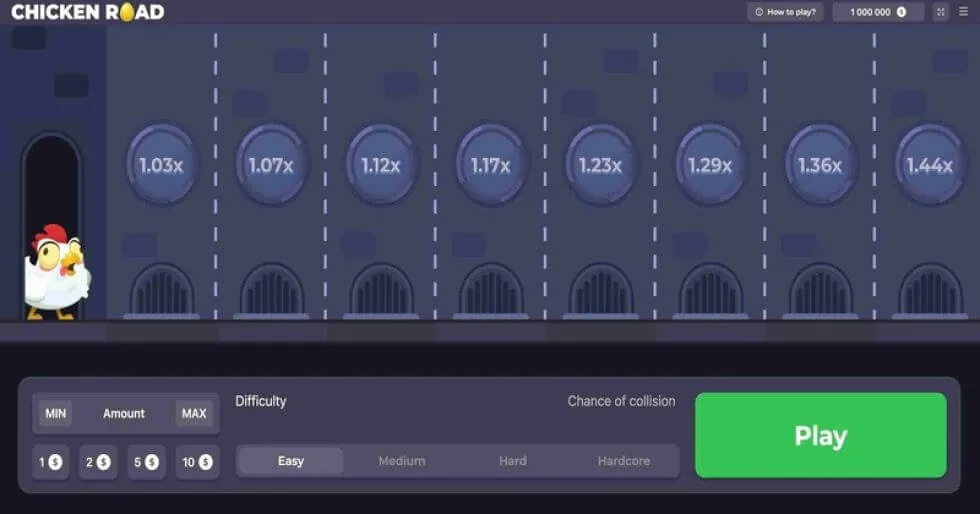
Four circular bet buttons occupy the control strip at the base of the screen, offering £0.50, £1, £2 and £7 in dark grey with pale borders and white numerals. Click your preferred amount, then choose one of the four difficulty settings: Easy (30 lanes), Medium (25 lanes), Hard (22 lanes) or Hardcore (18 lanes). Medium is pre-selected by default and appears with a lighter shade and subtle glow. Higher tiers reduce lane count and increase traffic density, directly affecting collision risk without altering the multiplier values themselves. Once your stake and difficulty are confirmed, press the prominent green 'Play' button to begin.
2: Guide the Chicken Across Lanes
The white chicken starts at the bottom edge of the motorway. Click the next lane to advance, or enable 'Space to spin and go' in the settings menu to use the Space key for quicker input. Each lane displays a circular manhole icon with concentric rings and spoke patterns, acting as a progress marker that shows your active multiplier. Lane one applies 1.01×, and the factor climbs to 1.19× by lane six, compounding with every successful step. A turquoise car moves horizontally through the lanes; timing your advance to avoid collision is the central challenge. The difficulty tier you selected determines how many lanes remain and how dense the traffic becomes as you progress.
3: Cash Out or Continue
You may withdraw at any moment before entering the next lane, locking in your current compounded multiplier. The interface clearly displays your total at each checkpoint, so you know exactly what you stand to collect. If you choose to continue and the chicken is struck by the turquoise car, the round ends immediately and your wager is lost. There is no predetermined outcome: every forward step carries fresh collision risk, and the decision to stop or advance rests entirely with you. Once you cash out or lose, the round concludes and you return to the start zone, where the latest winner's username, profile image and prize amount appear in green with a plus symbol.
How Much Can You Win?
Chicken Road 2's payout structure is built on fixed per-lane multipliers that compound as you advance. Lane one applies 1.01× to your stake, rising to 1.19× by lane six. These factors stack: if you wager £1 and reach lane six without collision, your total reflects every multiplier collected along the way, not merely the final 1.19×. The circular manhole icons on each lane display your active multiplier, providing constant visibility into your current earnings.
The game does not disclose a published return-to-player percentage or a maximum win ceiling in the provided technical details. This absence of transparent caps and RTP figures makes it difficult to compare Chicken Road 2 directly with slots that publish such data. Experienced players accustomed to consulting RTP tables may find this lack of clarity frustrating, as it leaves strategic planning reliant on observed play rather than verifiable statistics. The four difficulty tiers alter lane count and traffic density but do not change the per-lane multiplier values, meaning higher difficulty increases collision likelihood without offering proportionally larger payouts.
- Lane one: 1.01× multiplier applied to your wager.
- Lane six: 1.19× multiplier, representing the peak single-lane factor.
- Compounding structure: each successful lane adds its multiplier to the running total, not just the final lane's factor.
- Difficulty tiers: Easy (30 lanes), Medium (25 lanes), Hard (22 lanes), Hardcore (18 lanes)—lane count drops as difficulty rises, but multiplier values remain constant.
- No published RTP or maximum win figure provided in the technical specification, limiting transparency for strategic comparison.
Strategies and Sensible Habits
Match Difficulty to Your Tolerance
Easy mode offers thirty lanes with sparser traffic, allowing you to accumulate multipliers at a steadier pace and cash out earlier if nerves rise. Medium balances exposure and payout scope across twenty-five lanes and is the default setting most players find workable. Hard compresses the route to twenty-two lanes with denser vehicle flow, sharply raising collision likelihood with each step. Hardcore presents just eighteen lanes and demands precise timing under maximum pressure. Select the tier that aligns with your appetite for risk; higher difficulty does not increase per-lane multipliers, so Hardcore is not inherently more profitable—it simply compresses the journey and raises the odds of being struck.
Set a Cash-Out Target Before You Begin
Decide in advance at which lane or multiplier you will collect, then stick to that threshold regardless of how the round unfolds. Players who chase 'just one more lane' after an initial cash-out plan often lose rounds they could have banked. The compounding multiplier structure rewards steady progression, but the absence of a published RTP means you cannot calculate an optimal stopping point with mathematical precision. Instead, choose a target that feels sustainable over multiple rounds—collecting at lane eight or ten, for instance—and treat any further advance as a conscious decision rather than impulse. This discipline prevents the emotional spiral that turns a profitable session into a losing streak.
Use Demo Mode to Gauge Traffic Patterns
The demo requires no account or payment method and operates with the same mechanics as real-money play, making it the most efficient way to observe how traffic density shifts across difficulty tiers. Spend several rounds testing each setting to identify the tier that matches your preferred pace and risk tolerance. Note the timing windows when the turquoise car crosses lanes and experiment with both mouse clicks and the Space key shortcut to determine which input method feels more responsive. Demo play does not replicate the psychological weight of staking real money, but it does familiarise you with lane layouts, multiplier checkpoints and the rhythm of safe advancement. Transitioning to real-money mode after thorough demo practice reduces costly mistakes born from unfamiliarity.
Free Demo or Real Money?
Chicken Road 2 offers a demo mode accessible without registration, deposit or payment method. The demo uses the same interface, multipliers, difficulty tiers and traffic patterns as the real-money version, providing a risk-free environment to test strategies and explore the four challenge settings. Fictional currency replaces pounds sterling, but every other element functions identically, making demo play a practical rehearsal rather than a stripped-down preview.
Real-money mode introduces genuine stakes and the psychological pressure that accompanies them. The live wins feed at the top streams actual payouts from other players, reinforcing that collected multipliers convert to withdrawable funds. Partner casinos hosting Chicken Road 2 typically require account verification and responsible gambling tools such as deposit limits and session timers. Remember that mini-games and slots lose money over time; the house edge ensures that, across thousands of rounds, player losses exceed winnings. RTP figures represent long-term averages and offer no guarantee for individual sessions. If you choose to play with real money, set a strict budget before you begin, treat losses as the cost of entertainment, and never wager funds you cannot afford to lose. Chicken Road 2 is designed for players aged eighteen and over, and responsible gambling resources are available through partner casinos should you need support.
Our Opinion
Chicken Road 2 succeeds in delivering transparent, incremental tension through its lane-by-lane multiplier structure. The fixed factors—1.01× at lane one, climbing to 1.19× by lane six—compound visibly, and the circular manhole icons provide constant feedback on your current earnings. The four difficulty tiers give you direct control over volatility, a refreshing departure from slots that obscure variance behind vague labels. Easy mode's thirty lanes suit cautious players, while Hardcore's eighteen-lane sprint appeals to those who prefer concentrated risk. The interface is clean, the white chicken avatar is well rendered, and the live wins feed adds a layer of community engagement absent from static slot titles.
However, the absence of published RTP figures and a disclosed maximum win ceiling is a significant shortcoming. Experienced players rely on these metrics to compare games and plan sessions, and Chicken Road 2 offers neither. The per-lane multipliers remain constant across difficulty tiers, meaning Hardcore increases collision likelihood without proportionally raising payout potential—a design choice that may frustrate those expecting higher stakes to yield higher rewards. The game also lacks the thematic depth and bonus features found in modern video slots; once you understand the traffic-dodging mechanic, replay value hinges entirely on your tolerance for repetition. The keyboard shortcut and demo mode are welcome conveniences, but they cannot compensate for the transparency gaps in the technical specification.
👍 Pros
- Transparent multiplier progression with visible checkpoints at every lane.
- Four difficulty tiers let you adjust volatility before each round begins.
- Demo mode requires no account or payment method, offering genuine risk-free practice.
- Clean interface with live wins feed and realistic chicken avatar animation.
- Keyboard shortcut (Space key) available for quicker, rhythmic input.
👎 Cons
- No published RTP figure or maximum win ceiling, limiting strategic transparency.
- Per-lane multipliers remain constant across difficulty tiers; higher difficulty raises collision risk without increasing payout factors.
- Limited thematic variety and no bonus features beyond the core traffic-dodging mechanic.
- Replay value depends entirely on tolerance for repetition once the mechanic is mastered.
Frequently asked questions
What is the RTP of Chicken Road 2?
InOut Games has not disclosed a return-to-player percentage for Chicken Road 2. The absence of published RTP data makes it difficult to compare the game's long-term payout profile with slots and mini-games that provide this figure.
How do the difficulty tiers affect payouts?
The four difficulty settings—Easy, Medium, Hard and Hardcore—alter the number of lanes (from thirty down to eighteen) and traffic density. Crucially, the per-lane multiplier values remain constant across all tiers, so higher difficulty increases collision likelihood without raising the payout factors themselves.
Can I use a keyboard shortcut instead of clicking?
Yes. Open the settings menu and enable 'Space to spin and go', which allows you to advance through lanes by pressing the Space key. This suits players who prefer quicker, more rhythmic input over mouse clicks.
Is Chicken Road 2 available on mobile devices?
The game is browser-based with an estimated resolution of 1920×1080, suggesting it is optimised for desktop screens. Compatibility with mobile browsers may vary depending on screen size and input responsiveness; testing the demo on your device is advisable before committing real money.
What happens if I am struck by the turquoise car?
Collision ends the round immediately, and your wager is lost. The game offers no second chances or partial refunds; once the chicken is hit, you return to the start zone and must begin a new round with a fresh stake.