
Unlike traditional slots that spin to a predetermined outcome, chicken-crossing games demand active decisions at every step. The player chooses when to cash out, balancing greed against the risk of an oncoming obstacle. This review explains how the games work, what to look for when choosing a title, typical mistakes that erode bankrolls, and where to try them risk-free in demo mode.
Games tested: chicken games

- Chicken Road — The original that defined the genre, offering straightforward lane-dodging and a transparent multiplier ladder.
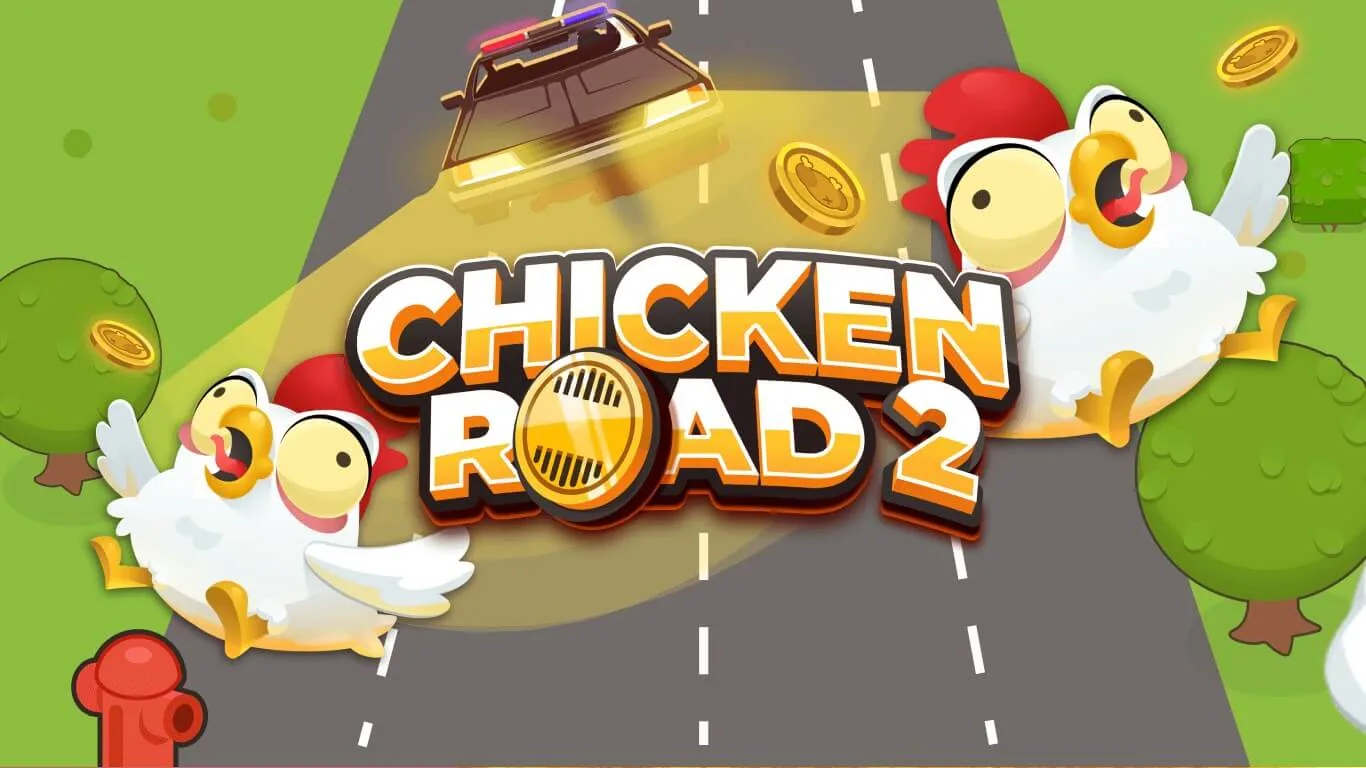
- Chicken Road 2 — Adds diagonal movement and faster traffic patterns, rewarding experienced players who seek higher volatility.
Comparison table
| Game | Provider | Principle | Who it suits |
|---|---|---|---|
| Chicken Road | InOut Games | Five-lane grid, orthogonal movement, moderate obstacle speed | Beginners seeking straightforward mechanics and steady multiplier growth |
| Chicken Road 2 | InOut Games | Seven-lane grid, diagonal steps allowed, faster traffic and higher top multiplier | Experienced players comfortable with increased volatility and split-second decisions |
What chicken games are and how they work
A chicken game presents a grid of lanes – roads, rail tracks or rivers – populated by moving obstacles: cars, trains, logs. The player taps or clicks to move the chicken forward one row at a time. Each successful crossing increases a multiplier, typically starting at 1.00× and climbing in fixed increments. The round continues until the player cashes out or the chicken collides with an obstacle, forfeiting the entire stake.
The core mechanic mirrors crash games: a rising curve that can end without warning. The difference lies in player agency. In a crash game the multiplier climbs automatically and the only decision is when to exit; in a chicken game every forward step is a deliberate choice, and the player can pause indefinitely before committing to the next move. Obstacle patterns are generated by a random-number generator, certified by testing laboratories in regulated markets, though the 'provably fair' label often seen in crypto casinos guarantees transparency of the algorithm rather than favourable odds.
Return-to-player percentages in chicken titles usually sit between 96 and 98 per cent, comparable to mid-range slots. That figure is a long-run average across millions of rounds; individual sessions will deviate sharply. Variance tends to be high because payouts are back-loaded: reaching the final rows can yield multipliers of 10× or more, but the majority of attempts end in early collisions with modest returns or total loss.
Choosing the right chicken game
When comparing titles, consider lane count, obstacle speed and payout structure. Chicken Road uses a five-lane grid with moderate traffic density; Chicken Road 2 expands to seven lanes and permits diagonal steps, raising both the skill ceiling and the house edge slightly. More lanes mean more escape routes but also more visual information to process under time pressure.
Volatility is another differentiator. Some variants increase the multiplier in small, steady increments – appealing to conservative players who cash out after a handful of safe crossings. Others front-load risk by spacing obstacles tightly in early rows, then offering exponential multiplier growth in later stages. Check the paytable or help screen: if the final-row multiplier exceeds 20×, expect frequent wipeouts and rare big wins. If the top multiplier is modest, the game rewards patience over risk-taking.
Mobile optimisation matters more here than in passive slots. Chicken games require quick taps and clear lane visibility; a sluggish interface or small hit-boxes on a phone screen will cost you rounds. Test the demo on your preferred device before committing real money. Finally, verify that the operator holds a licence from the UK Gambling Commission or an equivalent regulator. Unlicensed sites may offer chicken games with altered RTPs or unaudited RNGs.
Classic mistakes that lose money
The most common error is treating early rows as risk-free. Even the first crossing carries collision probability; players who tap carelessly, assuming the game 'warms up' gradually, meet an obstacle within seconds and lose their stake before the multiplier has moved. Always scan the visible lanes before each step, especially when obstacles are staggered or accelerating.
Chasing losses by increasing stakes after a collision is equally destructive. Because outcomes are independent, a string of early failures does not make a deep run more likely on the next attempt. Raising your bet in frustration simply drains the bankroll faster. Stick to a fixed stake size and accept that variance will produce clusters of losses regardless of skill.
Over-confidence after a lucky streak is the flip side of the same problem. A player who reaches row twelve twice in a row may begin to believe they have mastered the rhythm, then push for row fifteen and collide. The RNG does not reward or punish streaks; each step is a fresh probabilistic event. Cash out according to your pre-set target, not your recent history.
Finally, neglecting to set a session budget turns a twenty-minute diversion into an hour-long deficit. Chicken games are faster-paced than slots – a round can last ten seconds or three minutes – so losses accumulate quickly. Decide in advance how much you can afford to lose, divide that sum into a sensible number of base bets, and stop when the budget is exhausted. Responsible gambling tools, such as deposit limits and session timers, are mandatory in UK-licensed casinos and should be configured before you start.
Where to practise in demo mode
Most reputable online casinos that host InOut Games titles offer a demo toggle, allowing unlimited play with virtual credits. Demo mode uses the same RNG and paytable as real-money rounds, so it provides an accurate preview of volatility and lane patterns. Use it to test timing: how fast do obstacles move? Can you reliably thread a gap between two cars? How many rows can you clear before your concentration wavers?
Demo play also lets you experiment with different strategies without financial consequence. Try cashing out at a fixed multiplier – say, 3× – for ten consecutive rounds and note the success rate. Then attempt to reach row ten every time and compare the results. You will quickly discover whether aggressive progression or cautious increments suit your temperament and reflexes.
Be aware that demo mode can create a false sense of security. Virtual credits cost nothing to replenish, so players often take wilder risks than they would with real money. When you switch to cash play, adrenaline and loss aversion change decision-making. Use the demo to learn mechanics and set realistic targets, but do not assume your demo win rate will transfer directly to funded sessions.
Payouts and what to expect
Payout scales in chicken games are stepwise rather than continuous. Each row crossed adds a fixed multiplier increment – often 0.20× to 0.50× in the early rows, rising to 1.00× or more in the final third of the grid. A typical twelve-row game might pay 6× for reaching row ten and 15× for clearing all rows, though exact figures vary by title and configuration.
Because the player controls progression, theoretical RTP assumes optimal play – cashing out at the moment expected value peaks. In practice, few players achieve that optimum; most either bail out too early, leaving value on the table, or push too far and hit an obstacle. The published RTP of 97 per cent, for instance, includes both the player who cashes at 2× after two rows and the one who reaches 12× on row eleven. Your personal return depends on discipline and luck in equal measure.
Maximum win caps exist but are rarely disclosed prominently. Some titles limit total payout to 10,000× the base bet, others to a fixed sum such as £25,000. If you are betting £10 per round and reach a 15× multiplier, you collect £150; scale that stake to £100 and a regulatory or operator cap may truncate the prize. Check terms and conditions if you plan to bet above the minimum.
Responsible gambling and final thoughts
Chicken games sit at the intersection of skill perception and pure chance. The illusion of control – you tap the screen, you see the chicken move – can obscure the fact that obstacle placement is random and the house edge immutable. No amount of practice will shift the RTP in your favour, though familiarity with lane patterns may reduce unforced errors.
Set firm limits before you play. Decide the maximum you will lose in a session, the maximum time you will spend, and a profit target at which you will stop. Use the reality-check reminders and deposit limits mandated by the UK Gambling Commission. If you find yourself playing longer than intended, increasing stakes to recover losses, or feeling anxious between sessions, seek support from organisations such as GamCare or BeGambleAware. Chicken games are designed for entertainment; when they become a source of stress or financial harm, it is time to step away.
For players who enjoy reflex-driven games and can accept high variance, chicken-crossing titles offer a refreshing alternative to spinning reels. Chicken Road and Chicken Road 2 remain the benchmarks, balancing accessibility with enough depth to reward repeated play. Approach them with realistic expectations, a fixed budget, and the understanding that the house always holds an edge – and you will find them a diverting, if unpredictable, addition to your casino portfolio.
Frequently asked questions
Can I improve my odds with practice?
Practice helps you recognise lane patterns and avoid careless taps, but the RNG and house edge remain constant. Skill reduces unforced errors; it does not alter the mathematical expectation.
What is the best multiplier to cash out at?
There is no universal answer. Conservative players often exit at 2× to 3×, accepting smaller but more frequent wins. Aggressive players aim for 10× or higher, tolerating longer losing streaks. Match your target to your bankroll and risk tolerance.
Are chicken games provably fair?
Some operators offer cryptographic verification of each round's RNG seed, allowing you to confirm the outcome was not manipulated. However, 'provably fair' does not mean favourable odds; the house edge is baked into the game design and remains regardless of transparency.