
Unlike traditional slots that spin symbols into patterns, Tower Rush rewards calculated risk management. You decide whether to secure modest early returns or push toward exponential upper-tier multipliers, knowing that a single failed floor ends the round instantly. The 98.5% RTP and £10,000 maximum win deliver a transparent mathematical framework, but outcome variance remains sharp enough to separate cautious climbers from those chasing the summit.
Tower Rush: key facts
| Provider | Galaxsys |
|---|---|
| Type | Crash / Tower-building game |
| RTP | 98.5% |
| Volatility | High |
| Min / max bet | £0.01 / £100 |
| Max win | £10,000 |
| Mobile | Yes |
| Demo | Yes |
A taut tower-climbing experience that rewards strategic exits and punishes hesitation, backed by transparent maths and clean execution.
What is Tower Rush?
Tower Rush sits in the crash-game family, replacing the ascending curve of traditional crash titles with a discrete 36-floor tower structure. Each floor corresponds to a fixed multiplier value that grows as you climb, transforming your bet into larger potential winnings with every successful level. The catch: a predetermined but hidden collapse point lurks somewhere in the tower, and reaching it before cashing out forfeits every penny you've accumulated.
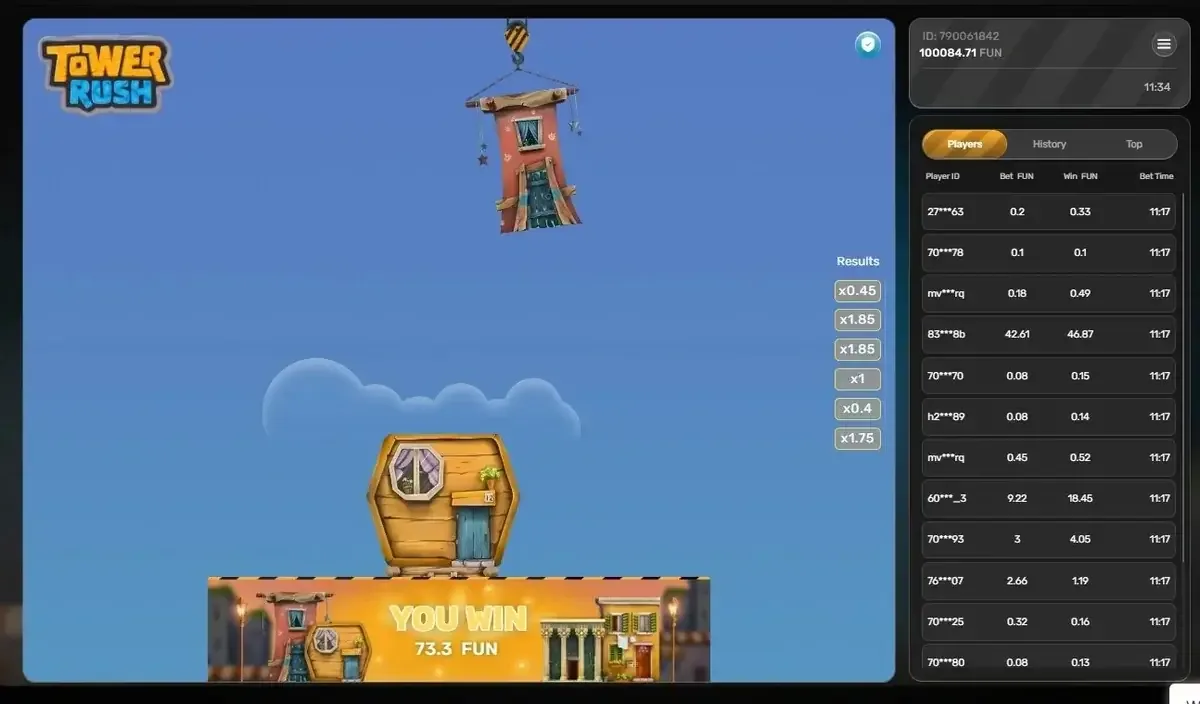
Galaxsys built Tower Rush around provably fair algorithms, meaning the collapse floor is determined at round start and verifiable through cryptographic checks. You won't know where disaster strikes until you either trigger it or cash out safely, creating the tension that defines the genre. The visual presentation is clean and functional—a vertical tower display shows your current position, active multiplier, and potential payout, updating in real time as you advance.
Three bonus floor types inject strategic wrinkles into standard climbs. Frozen Floor locks your total win amount temporarily, Temple Floor offers unspecified advantages, and Triple Build accelerates progression. These mechanics appear randomly during ascents, adding tactical layers beyond simple risk-reward calculations. The game strips away thematic decoration in favour of pure climbing mechanics, appealing to players who prefer transparent systems over elaborate set dressing.
How to play Tower Rush?
1: Set your stake and initiate the climb
Choose a bet between £0.01 and £100 using the stake selector. The interface displays your selected amount prominently, along with the current multiplier that will apply when you begin. Once satisfied with your wager, activate the climb to start ascending the tower. Your stake is deducted immediately, and the first floor becomes active. Early floors carry low multipliers—typically under 2×—but represent near-certain progression, establishing your baseline profit before volatility intensifies higher up.
2: Advance through floors and monitor multipliers
Each successful floor placement increases your active multiplier according to a fixed schedule visible in the game interface. The tower structure shows which level you currently occupy, how many remain above, and the potential payout if you cash out now. As you climb, multipliers compound—what started as a modest 1.2× at floor three might reach 5× by floor fifteen and spike toward triple digits in the upper third. The screen updates instantly with each level conquered, keeping your potential winnings front and centre whilst tension mounts.
3: Cash out before the tower collapses
Press the cashout button at any point after clearing the first floor to transfer your accumulated winnings to your balance. The moment you cash out, the round ends and your profit is confirmed—no further risk, no additional floors. If you continue climbing and hit the collapse floor, you lose everything accumulated during that ascent, returning to zero regardless of how high you'd climbed. The cashout button remains active throughout your climb, placing the exit decision entirely in your hands. Automated cashout settings let you predefine an exit multiplier, removing hesitation and executing your strategy with mechanical precision.
How much can you win?
Tower Rush caps maximum winnings at £10,000 per round, achieved when your bet multiplied by the final multiplier reaches that ceiling. With a £100 maximum stake, you'd need a 100× multiplier to hit the limit—a level situated well into the upper tower floors where collapse risk runs highest. Smaller bets require proportionally higher multipliers to approach the ceiling, meaning a £1 wager would need the full 10,000× theoretical maximum, a figure that exceeds the 36-floor structure's top multiplier.
The advertised maximum win reflects the game's hard payout cap rather than the highest multiplier achievable through standard play. Reaching the summit floor typically delivers multipliers in the hundreds rather than thousands, so the £10,000 ceiling functions more as a safety limit for large-stake climbers who reach extreme heights. Practical win potential depends on three factors: your stake size, how high you dare climb, and whether you cash out before hitting the predetermined collapse point.
- Early floors (1–12): Multipliers range from approximately 1.1× to 3×, offering safe but modest returns suitable for risk-averse sessions or bankroll preservation strategies.
- Mid-tower (13–24): Multipliers accelerate into the 3× to 10× range, where profit potential justifies moderate risk and collapse probability begins climbing noticeably.
- Upper floors (25–36): Multipliers explode exponentially, potentially reaching 100× or beyond, but collapse risk intensifies dramatically—this is where fortunes are made or obliterated.
- Maximum theoretical win: £10,000 hard ceiling applies regardless of multiplier, protecting the operator whilst still delivering substantial profit potential for bold climbers with adequate stakes.

Strategies and good habits
Establish exit targets before climbing
Decide your cashout multiplier before placing any bet, removing emotional interference from in-the-moment decisions. Setting a 5× target means you exit automatically when reaching that level, banking consistent profits rather than chasing ever-higher returns. Use the auto-cashout feature to enforce this discipline—programme your chosen multiplier and let the system execute your plan without hesitation. Test different exit points across multiple rounds to identify which targets suit your risk tolerance and capital base, then stick to successful thresholds rather than constantly adjusting mid-session.
Scale stakes to match climbing ambition
Aggressive high-tower strategies demand smaller stakes to survive inevitable losses, whilst conservative early-exit approaches can support larger bets. If you're targeting the upper third of the tower where multipliers spike but collapse risk intensifies, bet a fraction of your session bankroll per round—perhaps 1% to 2%—so failed climbs don't cripple your capital. Conversely, cashing out at low multipliers (under 3×) produces frequent small wins that tolerate larger individual stakes. Match your bet sizing to your climbing strategy rather than wagering uniformly regardless of tactical approach.
Study session data without overthinking patterns
Tower Rush displays recent round outcomes and other players' cashout behaviour in real time, providing context for your own decisions. Note where collapses frequently occur and which floors see heavy exit activity, using this information to calibrate your own targets. However, remember that each round's collapse point is predetermined and independent—past results don't influence future outcomes, so avoid the gambler's fallacy of expecting 'due' safe climbs after several crashes. Use the data to inform stake sizing and exit strategy, not to predict individual round outcomes.
Respect the 98.5% RTP reality
Tower Rush returns 98.5% of total stakes to players over the long term, meaning the house retains 1.5% as its mathematical edge. This figure is excellent by industry standards—most slots run between 94% and 96%—but still guarantees that sustained play trends toward net losses. Treat each session as entertainment with costs attached rather than income generation. Set loss limits before starting, never chase deficits with larger stakes, and walk away when you hit predefined stop points. The high RTP softens variance but doesn't eliminate the structural disadvantage.
Free demo or real money?
Tower Rush includes a demo mode that replicates full gameplay using virtual currency, letting you test mechanics, explore multiplier progression, and refine exit strategies without financial risk. The demo operates identically to real-money play—same RTP, same floor structure, same bonus types—so skills and observations transfer directly when you switch to cash stakes. Use demo sessions to establish which cashout multipliers suit your temperament, experiment with auto-bet sequences, and familiarise yourself with the tower's visual feedback before committing actual funds.
Demo mode serves multiple purposes beyond simple practice. New players can grasp the timing-based mechanics without the pressure of live stakes, whilst experienced climbers can test aggressive high-floor strategies that would devastate a real bankroll if executed recklessly. The mode also lets you verify the game's rhythm and interface responsiveness on your device before depositing at a partner casino. However, demo wins carry no emotional weight—the absence of genuine risk fundamentally alters decision-making psychology, so expect your real-money behaviour to differ from demo habits.
Once comfortable with mechanics, transition to real stakes at reputable online casinos that host Galaxsys titles. Start with minimum bets to acclimate to the psychological shift, then scale up only after demonstrating consistent discipline across multiple sessions. Many operators offer modest bonuses that can extend your initial climbing bankroll, though always read wagering requirements carefully—some promotions restrict crash-game play or impose unfavourable contribution rates. Real-money play introduces genuine tension and reward, transforming Tower Rush from a mechanical exercise into a proper test of risk management and nerve.
Our opinion
Tower Rush delivers precisely what it advertises: clean crash-game mechanics wrapped in a vertical climbing framework. The 98.5% RTP ranks among the industry's highest, reducing the house edge to a sliver whilst maintaining operator viability. Galaxsys stripped away unnecessary decoration, focusing entirely on the core tension between greed and caution that defines crash titles. The 36-floor structure provides clear progression milestones, and the £10,000 ceiling offers genuine win potential without overpromising.
The bonus floor mechanics—Frozen, Temple, and Triple Build—add tactical depth beyond pure multiplier chasing, though their random appearance means you can't build strategies around them reliably. Auto-cashout functionality proves essential for disciplined play, removing emotional interference from exit decisions and enabling systematic strategy testing. The game's transparency is refreshing: no hidden mechanics, no ambiguous features, just straightforward risk-reward mathematics executed with technical competence. It won't revolutionise the crash genre, but it executes familiar concepts with precision and respects player intelligence by presenting information clearly rather than burying it in marketing gloss.
👍 Pros
- Exceptional 98.5% RTP reduces house edge substantially compared to most slots and mini-games
- Clear 36-floor structure provides concrete progression milestones and strategic exit points
- Auto-cashout feature enables disciplined play by removing emotional decision-making from critical moments
- Provably fair algorithms ensure transparency and verifiable randomness for every round
- Clean interface prioritises essential information—multipliers, position, potential payout—without distracting clutter
👎 Cons
- High volatility produces sharp swings that can devastate bankrolls during unlucky sequences despite excellent RTP
- Bonus floor mechanics appear too randomly to incorporate reliably into strategic planning, feeling more like decoration than meaningful tactical options
Frequently asked questions
What does the 98.5% RTP mean in practice?
The 98.5% return-to-player rate means Tower Rush pays back £98.50 for every £100 wagered across all players over the long term. This figure represents a statistical average calculated over millions of rounds—individual sessions will vary wildly due to the game's high volatility. The 1.5% house edge is among the lowest in the industry, but it still guarantees that sustained play trends toward net losses. Use the high RTP to your advantage by managing bankroll carefully rather than expecting it to deliver consistent profits.
Can I predict where the tower will collapse?
No. Each round's collapse point is predetermined using provably fair algorithms at the moment you place your bet, but it remains hidden until revealed through gameplay. Past results don't influence future outcomes—if five consecutive rounds collapsed at floor twelve, the sixth round's collapse point is still independent and could occur anywhere from floor one to floor thirty-six. The session data showing recent crashes provides context for calibrating your exit strategy but offers zero predictive power for individual rounds.
How do the bonus floors work?
Frozen Floor, Temple Floor, and Triple Build appear randomly during climbs, altering standard progression temporarily. Frozen Floor locks your accumulated win amount, preventing loss if you continue climbing past it—though details on duration aren't specified by the provider. Temple Floor offers unspecified advantages that likely involve multiplier boosts or extended safe zones. Triple Build accelerates your ascent, letting you clear multiple floors simultaneously. Because these bonuses trigger unpredictably, you can't build strategies around them; treat them as occasional advantages rather than reliable tactical tools.
Should I use auto-cashout or manual exits?
Auto-cashout removes emotional interference by executing predetermined exit points with mechanical precision, making it ideal for disciplined strategy testing and bankroll preservation. Set your target multiplier—say, 5×—and the system cashes out automatically when you reach that floor, eliminating hesitation and second-guessing. Manual control suits players who want flexibility to react to bonus floors or adjust exits based on session momentum. New players benefit from auto-cashout whilst learning the game's rhythm; experienced climbers might prefer manual control once they've established consistent decision-making discipline.
Is Tower Rush available on mobile devices?
Yes. Tower Rush runs smoothly on smartphones and tablets through mobile browsers, requiring no separate app download. The interface scales appropriately to smaller screens whilst maintaining essential information visibility—current floor, active multiplier, cashout button—so you can climb comfortably on the go. Touch controls respond crisply, and the game's technical performance matches desktop quality. Test responsiveness in demo mode on your specific device before committing real stakes, ensuring the cashout button registers reliably under your typical usage conditions.